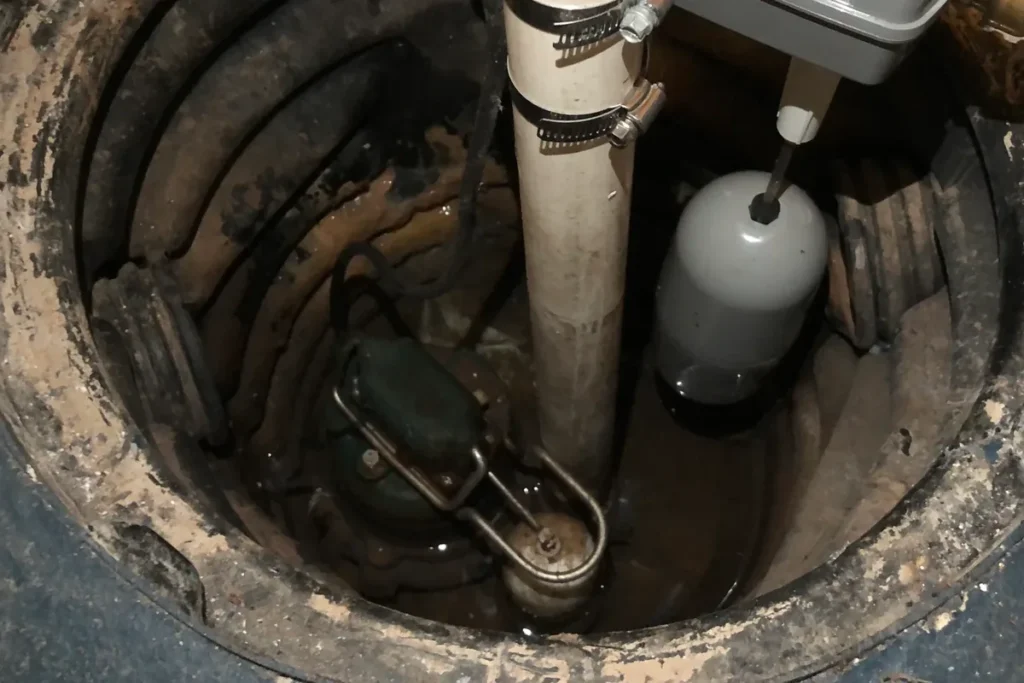
Plumbing Services Ottawa installs backwater valves across Ottawa, permitted and inspected, and flags whether your property looks eligible for the City rebate first.
Permit and inspection handled
Installed inside and kept accessible
Rebate guidance before work starts
Get a Backwater Valve Quote
Tell us about your project and we will get back to you within 24 hours.
Your information is secure and never shared.
What a Backwater Valve Does and Where It Has to Sit
A backwater valve is a one-way gate on your sanitary or storm lateral that stays open for normal drainage and slams shut if sewage tries to travel back toward the house. That reversal happens when the municipal system surcharges during heavy rain or rapid melt, and the pressure has to go somewhere. Without a valve, the release point is the lowest opening in your plumbing, which in most Ottawa homes is a basement floor drain, a laundry standpipe or a basement shower. The valve does not stop water getting into a basement through a crack or a window well, and it does not pump anything – it simply refuses to let the sewer come back up your own pipe.
Code placement
Inside the Dwelling, and Left Reachable
The Ontario Building Code requires the valve to be installed inside the dwelling and to remain accessible for inspection and maintenance, which rules out burying it in the yard, under a slab with no cover, or behind a finished basement wall. In practice that means cutting the floor, setting the valve body on the main line so everything you want protected drains through it, and finishing with an access cover left flush and exposed. That cover matters more than people expect: the flap seals against a machined seat, and hair, wipes and grease can hold it fractionally open, so it has to be openable without a demolition hammer. Where the weeping tile discharges into the lateral by gravity rather than into a pit, closing that line also closes the groundwater path, which is why a sump pit and pump are often specified at the same time.
Ottawa's Backwater Valve Rules
What the City and the Building Code require, regardless of who installs it.
Mandatory on New Construction
Required on the sanitary line for homes built after January 1, 2012, and on the storm line for homes built after January 1, 2004.
Permit and Inspection Required
Every backwater valve installation needs a City building permit and an inspection to close it out, on a new build or a retrofit.
Inside the Dwelling, Kept Accessible
The Code requires the valve inside the home with permanent access for inspection and cleaning – it cannot be sealed under a finished floor.
The City Rebate and the Permit Clock
If your home predates those cutoff dates a valve is not mandatory, but the City's Residential Protective Plumbing Program currently rebates up to $2,500 for an exterior storm backwater valve or $1,000 for an interior sanitary valve, plus the full building permit fee. The mechanics matter as much as the amounts. The rebate applies to a new installation, not to replacing a device that is already there. The application has to reach the City within 12 months of the permit date, so the permit is the clock, not the invoice. Storm-side devices are aimed at homes built before 2004 and sanitary-side devices at homes built before 2012, which is the mirror image of the mandate dates. We can flag whether a property looks eligible before work starts and make sure the permit paperwork is in a shape you can submit, but final eligibility is confirmed by the City's own program, not by us.
What a Compliant Installation Includes
The sequence that keeps the permit clean and the rebate application viable.
Permit before the floor opens
A City building permit filed before the basement floor is opened, because the permit date starts the rebate clock.
A CSA-approved valve
A device suited to the line it is being fitted on, storm or sanitary.
Placement inside the dwelling
On the line carrying everything you want protected, not buried in the yard.
An access cover left exposed
Flush and reachable, never sealed under new flooring or behind a finished wall.
Inspection before backfill
A City inspection while the valve is still visible, before the fill and concrete go back over it.
The permit closed out
With the paperwork in the form the rebate application needs.
There is a real choice in what the valve is and where it goes on the line. A mainline valve protects everything downstream of it, which is the usual objective, and the trade-off is that while it is closed nothing at all can leave the house. A branch or fixture valve protects only one part of the system, which sometimes suits a finished basement with a single vulnerable bathroom. Full-port designs let a drain camera pass through the body, which matters if the lateral beyond it ever needs inspecting, whereas some flap designs do not. Some valves carry an alarm that signals when the gate has closed, which is genuinely useful because a closed valve is exactly the moment to stop running laundry and showers. On a semi-detached or row property with a shared lateral, the connection arrangement has to be established before anything is specified, since a valve on the wrong side of a shared junction protects the neighbour instead of you.
What the Installation Involves
A retrofit is a concrete job as much as a plumbing job, and the quote reflects that.
Locating the Line
Finding the main lateral, its depth and its direction of flow, and choosing a point inside the dwelling where the cover can stay accessible afterward.
Permit Before Digging
The City building permit is filed before the floor is opened, because the inspection that closes the permit has to see the valve before it is covered.
Cut, Fit, Inspect, Restore
Saw-cutting the slab, cutting the valve into the line, the City inspection, then backfill and concrete with the access cover set flush.
What a Retrofit Costs, and What It Needs Afterward
Cost on a retrofit is driven by what is above the pipe and how deep it runs, not by the valve itself. An unfinished basement with a shallow lateral near an existing cleanout is the straightforward version. A finished basement means flooring, a subfloor and sometimes a wall come out first and go back after. Older cast iron laterals in the pre-war core can need a section replaced either side of the valve because the pipe will not take a clean cut and a coupling. Once installed, the valve needs looking at roughly once a year: open the cover, check the flap and the seat are clean, confirm the gate swings freely. It is also worth knowing how the valve behaves in a storm, because while it is closed nothing can leave the house either, so heavy indoor water use during a surcharge event can back a fixture up on your own side of the gate. If you want the wider picture of flood protection plumbing in Ottawa, a valve is usually one half of the answer and a correctly sized sump system is the other.
Check Whether You Already Have One
A surprising number of owners do not know, and the answer changes both the quote and the rebate question before anything is booked.
Where to Look
On the basement floor near the front wall, on the side the lateral leaves toward the street, for a rectangular or round access cover set flush in the concrete. Many have a clear plastic lid so the flap can be seen without opening anything.
Note the Make and Model
Read it off the lid or the body. That decides which service parts fit, and whether the gate can be replaced without cutting the valve body out of the line.
It Settles the Rebate Question
The City program funds new installations, so replacing a valve that is already there is work you would be paying for yourself. Better to know that before the quote than after.
Why Plumbing Services Ottawa for Backwater Valves
A backwater valve is only worth what its installation and its paperwork are worth.
Permit and inspection handled
We pull the City building permit before the floor is opened and coordinate the inspection that closes it out.
Code-compliant placement
Installed inside the dwelling, on a line that carries everything you want protected, with the access cover left exposed and serviceable.
Rebate guidance before work starts
We flag whether the property looks eligible under the City program and keep the permit dates clean, with final confirmation through the City.
Written quotes
The concrete work, the restoration and the permit are priced up front, so a finished basement does not turn into a surprise line item.
Backwater Valve FAQs
Is a backwater valve required by law in Ottawa?
Only on new construction. Sanitary backwater valves are required for homes built after January 1, 2012, and storm valves for homes built after January 1, 2004. An older home is not required to have one, which is exactly the gap the City's rebate program is aimed at. If your basement has flooded through a floor drain before, the age of the house is the first thing to check.
How much is the City's backwater valve rebate, and what qualifies?
Currently up to $2,500 for an exterior storm backwater valve or $1,000 for an interior sanitary valve, plus reimbursement of the building permit fee. It applies to a new installation only, so swapping out a device you already have does not qualify, and the application has to reach the City within 12 months of the permit date. Confirm current amounts and eligibility with the City directly.
Do I really need a permit for this?
Yes. Every backwater valve installation in Ottawa needs a City building permit and an inspection, retrofit or new build. That is not just an administrative point: the inspector has to see the valve before it is covered over, and an unpermitted install cannot be inspected after the concrete goes back. It also cannot be submitted for the City rebate, which is where most of the money is.
Where does the valve have to be installed?
Inside the dwelling, on the line it is protecting, in a spot that stays permanently accessible. The Building Code is specific about accessibility because the valve has a moving flap that seals against a seat and needs to be opened and checked. It cannot be buried in the yard, sealed under new flooring, or hidden behind a finished wall with no hatch.
Does the valve need any maintenance once it is in?
Roughly once a year, and it is a five-minute job. Open the access cover, look at the flap and the seat, and clear anything caught on the sealing edge – wipes, hair and congealed grease are the usual culprits. Check the flap swings freely and drops back. If the cover is hard to open or the valve is weeping around the lid, have it looked at before storm season rather than during it.
If I install a backwater valve, am I protected from basement flooding?
From one cause of it. A valve stops sewage travelling back up your lateral during a municipal surcharge. It does nothing about groundwater rising under the slab, a failed sump pump, a burst supply pipe, or surface water coming in at a window well or a grade problem. Homes that flood repeatedly usually need the valve and a properly sized sump system together.
Related Flood Protection Services
Sump Pump Installation & Repair in Ottawa
Sump pump installation and repair in Ottawa – new pits, pump replacement, backup systems and guidance on the City's flood-protection rebate. Permit-compliant.
Basement flooding plumber in Ottawa – 24/7 emergency response, plus the sump pump and backwater valve work that stops the next one, with City rebate guidance.
Sewer lateral repair and replacement in Ottawa, camera-diagnosed before any digging – cast iron, clay and modern piping, commercial and residential properties.
Drain and sewer camera inspection in Ottawa – real-time footage, the defect located and depth-marked on the surface, and a written report you can act on.
To provide the best experiences, we use technologies like cookies to store and/or access device information. Consenting to these technologies will allow us to process data such as browsing behaviour or unique IDs on this site. Not consenting or withdrawing consent, may adversely affect certain features and functions.
Functional
Always active
The technical storage or access is strictly necessary for the legitimate purpose of enabling the use of a specific service explicitly requested by the subscriber or user, or for the sole purpose of carrying out the transmission of a communication over an electronic communications network.
Preferences
The technical storage or access is necessary for the legitimate purpose of storing preferences that are not requested by the subscriber or user.
Statistics
The technical storage or access that is used exclusively for statistical purposes.The technical storage or access that is used exclusively for anonymous statistical purposes. Without a subpoena, voluntary compliance on the part of your Internet Service Provider, or additional records from a third party, information stored or retrieved for this purpose alone cannot usually be used to identify you.
Marketing
The technical storage or access is required to create user profiles to send advertising, or to track the user on a website or across several websites for similar marketing purposes.