Recent Project in Richmond
A basement bathroom rough-in in Richmond built around a macerating upflush unit, with PEX hot and cold supply lines run through the new framing.
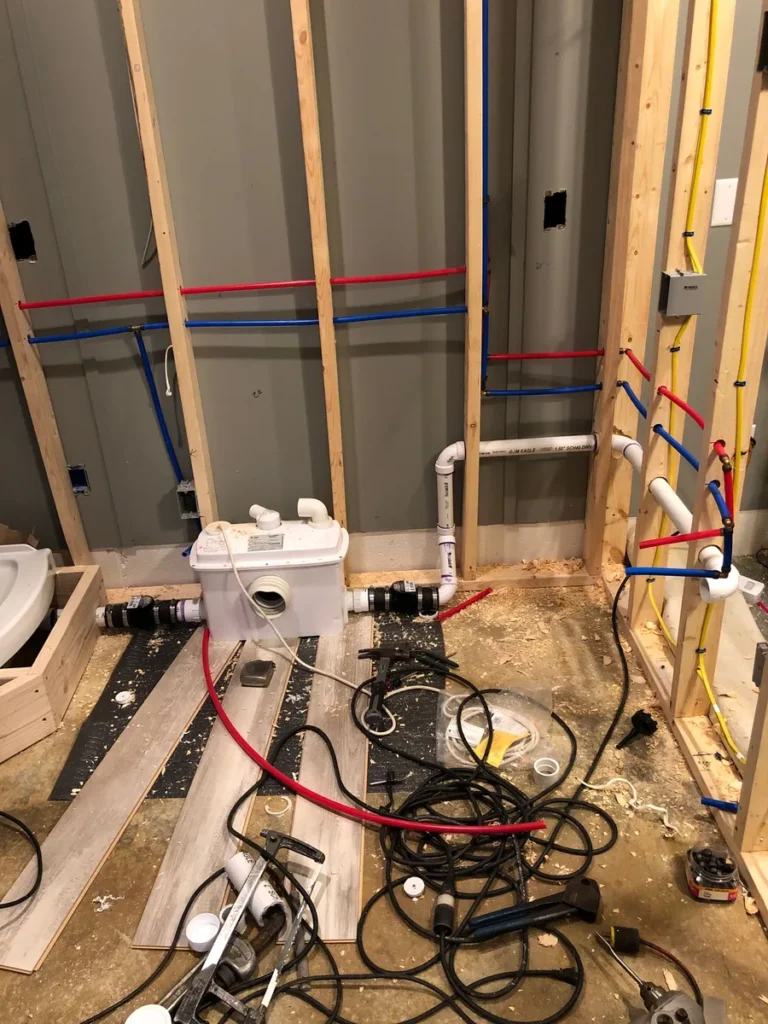
A basement bathroom rough-in in Richmond built around a macerating upflush unit, with PEX hot and cold supply lines run through the new framing.
Richmond is really two service areas that happen to share a name. Inside the village, houses are connected to municipal water and sanitary sewer, and the problems are the ones that come with old laterals and old drains: root intrusion at pipe joints, sections that have settled and cracked, and basements exposed to the sewer during a heavy storm. Step outside the serviced streets and you are on rural lots with their own drilled wells and septic systems, where there is no sewer to back up at all and the whole failure list changes to pumps, pressure tanks and leaching beds. Getting the right answer in Richmond starts with establishing which of those two properties you actually own, and that is not always obvious from the address alone.

The village sits on the Jock River in the west end of the City of Ottawa, in what used to be Goulbourn Township, and it is one of the older settlements in the region. Perth Street and McBean Street carry houses that predate anything in most Ottawa suburbs by a century, and the drains under them have been repaired, extended and partly replaced across a dozen different eras. Around that core sit mid-century infill, subdivision streets from the 1970s and 1980s, and a considerable amount of recent construction on the edges of the village. On one block a camera finds vitrified clay with roots in every joint, and on the next it finds clean plastic. The fairgrounds, the arena and the Perth Street businesses add a commercial layer on top of all of it.
Clay and cast iron laterals of unknown vintage, no backwater valve as built, and cleanouts that may have been paved or finished over.
Sound plastic drains and supply, where the failures are fixtures, water heaters and sump systems rather than the pipe in the ground.
Drilled wells, pressure tanks and septic beds on larger lots, with long exposed runs and their own water quality picture.
The Jock River is the fact that shapes everything else here. It runs straight through the village and it rises hard in spring, and even properties well back from the bank feel it as a water table coming up under the whole low-lying part of Richmond at the same time. Two things follow. Sump pumps in the older, lower streets do an entire year of work in a few weeks and fail exactly when they are needed, which is why a pour test in February is worth more than any amount of optimism in April. And the older sanitary sewer sections take on groundwater through cracked laterals and tired joints, so the same week that raises the river also raises the load inside the pipe, which is when a house with no working backwater valve finds out. Excavation near the river also sits in regulated floodplain territory, where the Rideau Valley Conservation Authority has a say alongside the City.
Richmond's older houses are exactly the ones the City's Residential Protective Plumbing Program was written for.
The program offers rebates toward a backwater valve, a sump pump and related flood protection on eligible homes built before January 1, 2004, along with the building permit fee.
Both a backwater valve installation and a new sump pit require a City plumbing permit and an inspection, rebate or no rebate.
It has to go inside the dwelling and remain reachable afterward, which matters a great deal if the basement is going to be finished later on.
We can tell you whether a Richmond property looks like a candidate before any work starts, but final eligibility is confirmed by the City, and the application is tied to the permit date rather than to the invoice.
Beyond the serviced streets, Richmond's rural properties run on the same terms as any private system in the west end of the city. The well is usually drilled, the pump is submersible, and the first sign of trouble is pressure that swings or a pump that cycles every few seconds because the tank has lost its air charge. Well water out here can carry hardness, iron and sediment, so staining on fixtures and laundry is worth treating at the source rather than fixture by fixture. The septic system needs pumping out on a regular interval and a leaching bed that has not been driven across, paved over or planted with anything ambitious. In a wet spring a bed sitting in ground already saturated by the Jock will struggle even when the tank itself is perfectly healthy, which is worth knowing before assuming the system has failed.
On a village property the camera settles the argument: material, distance to the fault, and whether this is a clearing job or a repair job.
A pour test through the full cycle in February, plus a walk outside to confirm the discharge is clear and falls away from the wall.
On rural lots, pump cycle and tank charge at the gauge, water quality at the entry point, and a septic history if anybody has one.
The commercial side of Richmond is village-scale and strongly seasonal. The shops and restaurants on Perth Street, the arena, the schools, the farm and feed businesses on the edges of the village and the fairgrounds all have plumbing that sits quiet for stretches and then gets used hard, which is a particular kind of stress. Traps dry out and let sewer gas into a building nobody has opened for a month, kitchen lines only clog during the busy weeks, and washroom blocks take a season of use in three days. Planning that work around the calendar rather than reacting to it is most of the job, and the same Ottawa plumbing repair and installation team handles the houses on those same streets.
If you own in the village core, the single most useful thing you can do is find out what your lateral is made of before it tells you. A camera inspection puts a number on it: clean plastic means you can stop thinking about it, roots in clay joints means either a clearing schedule or a decision about lining, and a belly holding standing water explains a drain that has been slow for years without anybody finding a blockage. If you own outside the village, the equivalent homework is knowing when the septic tank was last pumped out and what the pressure gauge does through a normal cycle. Both are cheap to establish and both head off the two in the morning version of the same problem.
Nothing gets excavated in the village core on a guess. The camera identifies the material, the distance and the fault before a price is written.
Richmond is inside the City of Ottawa, so backwater valve and new sump pit work is done under a City plumbing permit with the inspection it requires.
Serviced homes and rural wells and septic are different trades in practice, and we turn up equipped for whichever one your address turns out to be.
The village is serviced, but the surrounding rural lots are not, and the boundary is not always where people assume. Properties inside the village are on municipal water and sanitary sewer with a private lateral running from the property line into the house, while lots outside it run on drilled wells and their own septic systems. Which one you have changes the diagnosis completely, so it is the first thing we establish.
Yes. Richmond is part of the City of Ottawa, so City plumbing permits and inspections apply and the Residential Protective Plumbing Program is available to eligible properties. That program targets homes built before January 1, 2004, which describes a lot of the village core, and covers backwater valves, sump pumps and the permit fee. Final eligibility is always confirmed by the City rather than by a contractor.
Often yes. When the river comes up in spring it lifts the water table under the low-lying parts of the village, not just the properties beside it. That shows up as a sump pit filling far more often, weeping tile working hard, and groundwater finding its way into older cracked laterals. The practical response is to test the sump system in February rather than discover a dead pump in April.
Usually vitrified clay, cast iron, or a patchwork of both plus whatever material was used for repairs over the decades. Clay joints are where roots get in, and cast iron scales inward until the working diameter is a fraction of what it was. A camera run from the cleanout answers it in one visit, and knowing the answer decides whether you are on a clearing schedule or planning a repair.
Yes. Submersible pumps, pressure tanks, pressure switches and the supply line from the well head into the house, plus the drain side of a septic system inside the property. Water out here can carry hardness, iron and sediment, which is a genuine issue on a private well even though it is not one on Ottawa city water, and treatment belongs at the point the water enters the building.
Because the failure is groundwater rather than a blockage. A cracked or offset lateral takes on water when the table rises, and older sewer sections carry more than they were designed for during the same weeks, so a pipe that copes for eleven months surcharges in the twelfth. That is the pattern a backwater valve exists to protect against, and a camera run in a dry month shows where the water is getting in.