Recent Project in Kemptville
A new toilet installed in a compact Kemptville washroom, set on the flange, connected to the water supply and tested for leaks.
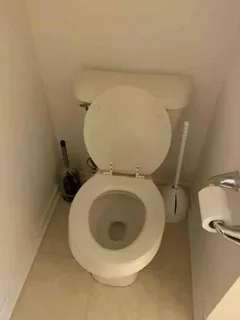
A new toilet installed in a compact Kemptville washroom, set on the flange, connected to the water supply and tested for leaks.
Kemptville is not part of the City of Ottawa, and that matters the moment a job needs a permit. The town is the main centre of the Municipality of North Grenville, roughly half an hour south of Ottawa down Highway 416, and it runs its own building department, its own water and wastewater system and its own bylaws. A plumbing permit for a Kemptville property is issued by North Grenville, the inspection is theirs, and any rebate or assistance program for flood protection here would be a North Grenville program. The City of Ottawa's Residential Protective Plumbing Program does not cross the municipal boundary, so nobody here should plan a backwater valve or sump project around it. We confirm the local requirements with the municipality before work starts, and we always suggest the owner confirm any rebate directly with North Grenville rather than taking a contractor's word for it.
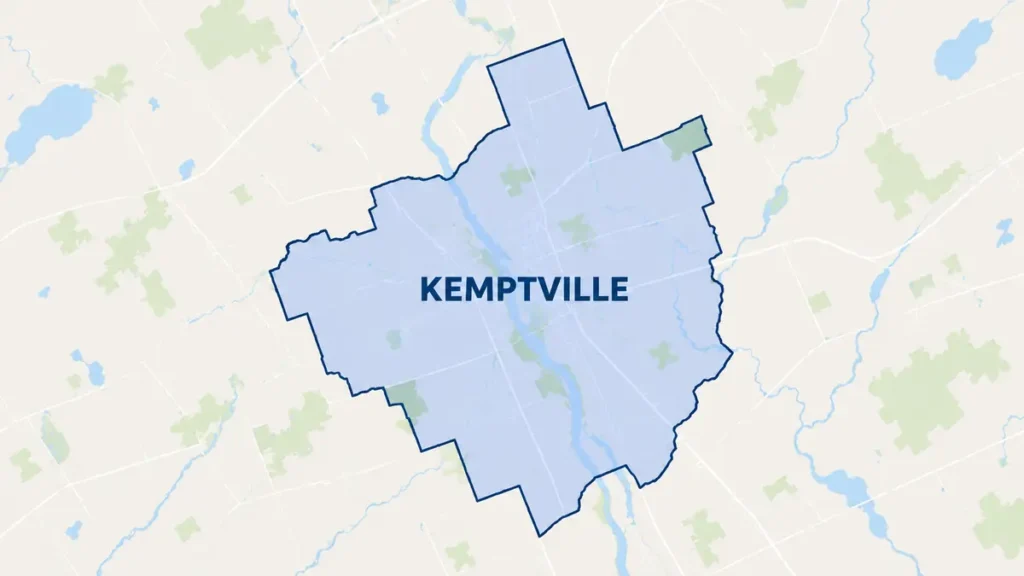
The town itself splits neatly in two. The old core around Prescott Street and Clothier Street, on the banks of Kemptville Creek, has houses and storefronts going back well over a century, on municipal water and sanitary sewer with private laterals that have been in the ground a very long time. Out from that, the subdivisions built through the 2000s and 2010s and the ones still going up along County Road 43 are modern construction on the same municipal system, with plastic drains and plastic supply throughout. Beyond the serviced boundary, North Grenville is farmland and hamlets, Oxford Mills, Bishops Mills and Burritts Rapids among them, where every property is on a private well and its own septic system. That is three genuinely different sets of problems inside one municipality.
Century-old houses and storefronts on municipal service, where the private lateral is the recurring failure and its material is often unknown.
Nothing worn out yet, so the calls are workmanship, hardware at the end of a short life, and sump systems facing their first real spring.
Outside the serviced boundary the whole system belongs to the owner, from the pump in the ground to the leaching bed in the field.
In the old core the failure that dominates is the private sewer lateral. The municipality maintains the main in the street, but the run from the property line into the house belongs to the owner, and on a property of that age it has usually been patched rather than replaced. Roots find the joints in older pipe, sections settle into soft ground near the creek and hold standing water, and cast iron narrows from the inside as it corrodes until barely half the original bore is left. The symptom is always the same and always misleading: a drain that has been slightly slow for years, then a backup on a bad day. A camera inspection is the only thing that separates a clog you can clear from a pipe you have to deal with, and it costs a fraction of what guessing costs. Kemptville Creek also rises in spring, lifting the water table under the low streets and pushing groundwater into old pipe through the same cracks.
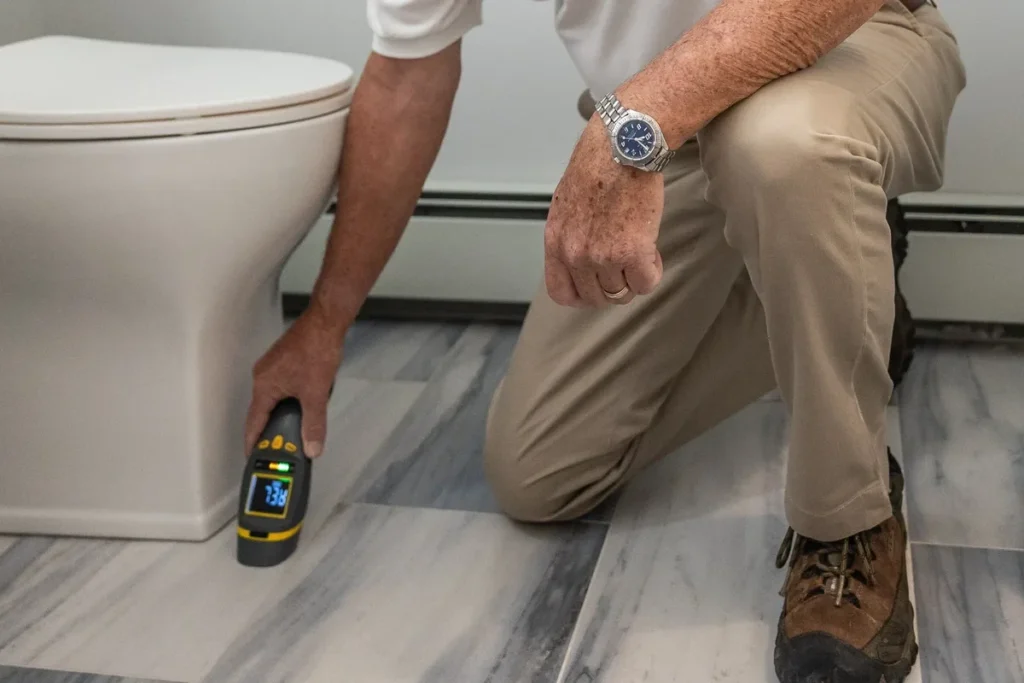
Nothing gets excavated on the strength of a guess. A camera run from the cleanout shows what the pipe is made of, where the fault sits, how far it is from the house, and whether the ground above it is a driveway, a mature tree or open lawn, and every one of those changes the price. If the pipe turns out to be sound and the blockage is grease or roots that can be cut and jetted, that is the cheaper answer and it is the one we give you.
The newer side of Kemptville has the opposite problem. Nothing there is worn out, so what shows up is workmanship and hardware: a drain run pitched slightly too flat that collects everything that passes, supply lines that were never properly strapped and hammer against the framing, a hose bib that cannot drain itself and cracks the first time the temperature really drops, and builder-grade fill valves and supply hoses giving out across a whole street at once. Whether a particular house was built with a backwater valve depends on when it went up and what was required here at the time, which is a North Grenville question rather than an Ottawa one, and the honest way to answer it is to go and look. If there is a valve, the cover needs finding and the flapper needs cleaning. If there is not, it is worth a conversation before the basement gets finished.
Outside the serviced area, North Grenville is well and septic country and the entire system is the owner's responsibility. Pressure that swings, a pump clicking on and off every few seconds, or a tap that sputters air all point at the well side rather than at anything inside the house, and the usual culprits are a pressure tank that has lost its air charge, a failing pressure switch, or a pump drawing down faster than the well recovers. Water quality is a live issue on a private well in a way it simply is not on a town system, so hardness, iron staining and sediment are ordinary findings out here and belong to be dealt with at the point the water enters the house. Septic tanks need emptying on a schedule somebody is actually keeping, and a leaching bed sitting in the heavier ground near the creek will labour through a wet spring even when the tank itself is perfectly healthy.
On a century-old core property the pipe is inspected before a price is written, so the quote reflects the fault rather than the worst case.
Permit and inspection requirements are confirmed with the municipality, never assumed from the City of Ottawa's rules.
Pumps, pressure tanks, switches and the drain side of a private system, for the rural properties beyond the serviced boundary.
Commercially, Kemptville punches above its size because it serves a wide rural catchment. The Prescott Street businesses, the restaurants and cafes, the retail and service buildings along County Road 43, the campus, the district hospital and the schools all draw from well outside the town, and the plumbing loads reflect that. Food service needs interceptors emptied on a set rotation, because the alternative is a callout at the worst possible hour, and any building with irrigation, a boiler feed or a fire line has backflow devices that need testing to the municipality's requirement. That work is scheduled rather than reactive, and the Ottawa-based plumbing company doing it is the same one on call overnight for a burst line in a house two streets away.
Useful advice here depends entirely on which of the three properties you own. In the old core, get a camera down the lateral while it is still behaving, and keep the cleanout accessible instead of paving over it. In a newer subdivision, walk the basement once a year looking for damp at the base of the walls, check the hose bibs after the first hard freeze, and replace the braided supply hoses under sinks on a schedule instead of after one lets go. On a rural property, track septic pumping dates and watch the pressure gauge. And on all three, ask North Grenville rather than us or the internet what a given permit or program actually requires.
North Grenville sets the permit and inspection process here, and we check it with the municipality instead of applying City of Ottawa requirements by habit.
We will not price a job on the basis of a City of Ottawa program that does not apply across the boundary, and we say so up front.
On old core pipe the inspection comes before the quote, so you are paying for the fault that exists rather than the one somebody guessed at.
Kemptville is covered overnight and on weekends as part of the service area south of Ottawa along the 416.
No. That program is run by the City of Ottawa for eligible addresses inside its own boundary. Kemptville sits in the Municipality of North Grenville, a separate municipality entirely, so the rebate is not available here and a flood protection job should be priced without it. If North Grenville runs a comparable program of its own, the municipality is the place to ask rather than a contractor.
The Municipality of North Grenville, through its own building department. Ottawa's permit process and Ottawa's requirements do not apply on this side of the boundary. Before work that needs a permit, we confirm what North Grenville requires for that specific job, and the property owner is welcome to confirm the same thing with the municipality, which is usually the fastest way to settle it.
The town is served by North Grenville's municipal water and wastewater system, and the run from the property line into the house is the owner's private lateral. Outside the serviced boundary, the rest of North Grenville is on private wells and septic systems. The two situations produce completely different problems, so establishing which one applies is the first question we ask.
Yes. Submersible and jet pumps, pressure tanks, pressure switches, foot valves and the supply line into the house, along with the drainage side of a private septic installation. Pressure that swings or a pump that short cycles is diagnosed at the gauge through a full cycle. Iron staining and hardness are genuine issues on a private well and belong to be dealt with where the water enters the building.
In the old core it is very often the lateral rather than a clog. A section that has settled into a belly holds standing water permanently, so everything slows down and a clearing only buys a few months. A camera run tells you which one you are dealing with, how far out the fault sits and what the ground above it looks like, and that decides whether the answer is a schedule or a repair.
Yes, it is a regular part of the service area rather than an exception, and the 416 makes it a straightforward run from Ottawa. Emergency dispatch covers Kemptville overnight and on weekends, and scheduled work such as camera inspections, commercial grease interceptor service and backflow testing is booked here the same way it is in the city.