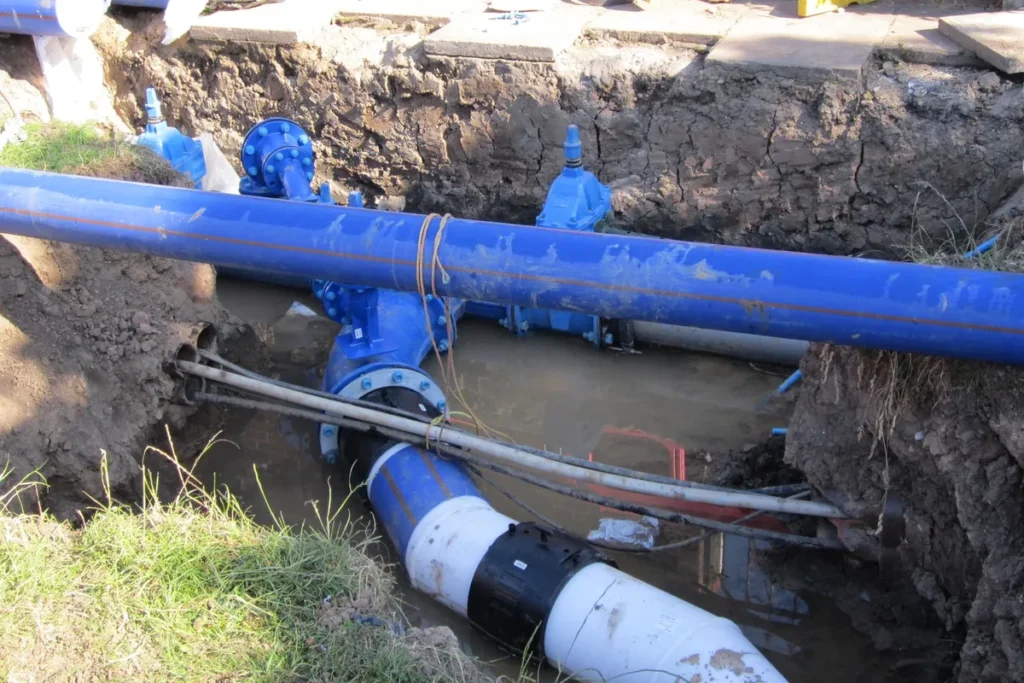
Plumbing Services Ottawa locates and repairs leaking and failed water service lines across Ottawa, on the private side of the shut-off.
Leak located before any digging
Point repair or full replacement
Commercial and residential
Get a Water Main Repair Quote
Tell us about your project and we will get back to you within 24 hours.
Your information is secure and never shared.
Whose Pipe Is It: The Ottawa Responsibility Split
On a water service line in Ottawa, the split is the shut-off valve. The City owns and maintains the line up to that valve; from the valve to your house, the pipe is yours, and so is the cost of repairing it. That private section usually runs under the front lawn, frequently under the driveway, and on some lots under part of the sidewalk or the road itself, which is why a leak on your side of the valve can turn into a much larger job than the length of pipe suggests. It is also worth knowing that private service line repairs generally fall outside standard homeowner insurance, so this is a cost most owners are meeting themselves. Confirming which side of the valve the leak is on is therefore the first job on the call, not the last.
Age and material
What the Pipe Is Tells You Most of It
Age and material tell you a lot before anyone digs. The 1950s to 1970s suburbs across Nepean, Alta Vista and parts of Gloucester were built with galvanised supply lines, and galvanised fails in two ways at once: it corrodes from the inside until the bore narrows and pressure drops across the whole house, and it eventually perforates at a thinned wall. Older properties in the pre-war core carry a mix of materials from several eras of replacement, so the line to the house is not always the line on the drawing. Post-2004 builds in Barrhaven, Findlay Creek, Riverside South and the newer Stittsville phases are generally copper or PEX and rarely fail from corrosion, but they can still be damaged by ground movement or by someone else’s excavation. Ottawa frost reaches roughly a metre in a typical winter, which is why services are buried as deep as they are, and repeated freeze and thaw cycles put real strain on a line that is already thin or poorly bedded.
Signs the Service Line Is Failing
A water main leak rarely announces itself with a flood. It announces itself with these.
Pressure Drop Across the House
Every fixture weakens, not one. On galvanised lines this comes on gradually as the internal bore narrows, so people adjust to it before they report it.
Water Bill That Will Not Explain Itself
A buried leak runs continuously. Close every fixture and watch the meter's low-flow indicator – if it is still moving, water is going somewhere.
Wet Ground or Running Water Sounds
A soft, unusually green or slow-drying strip along the line's path in dry weather, or the sound of water moving when the house is quiet.
Locating the Leak Before Anything Is Opened
Locating comes before excavation, always. We isolate at the shut-off to establish which side of the valve is losing water, pressure-test the private section, and use leak detection to narrow the position along the run rather than guessing from where the ground happens to be wet – water surfaces at the easiest path, not above the hole. Once the position is known, the access method decides most of the cost. A leak in open lawn is a small excavation and a repair coupling. A leak under a driveway means either lifting and relaying the surface or pulling a new line between two small pits, and on interlock or stamped concrete the restoration is often the larger half of the invoice. A line crossing under a sidewalk or the road brings permitting and municipal restoration requirements into the job, and the scheduling has to work around those. Season matters here too, because in an Ottawa winter a hard-surface repair may be closed with a temporary patch and permanently restored once asphalt is available again in spring.
What We Establish Before Anything Is Dug
Seven answers that decide the method, the price and the restoration.
Which side of the valve
Which side of the shut-off is losing water, so you are not paying to repair the City's section.
Material and age
The material and approximate age of the private line, which decides repair against replacement.
Route and depth
The line the pipe takes across the property, and roughly how deep it runs.
What sits on top of it
Lawn, interlock, stamped concrete, asphalt, sidewalk or roadway.
Trench or pull
Whether a new line can be pulled between two small pits instead of trenched end to end.
The restoration
What putting the surface back will take, and which parts of that are seasonal in an Ottawa winter.
Locates first
The other buried services sharing that corridor, marked before a shovel goes in.
The shut-off valves themselves deserve attention while the line is open, because they are the reason many of these calls become emergencies. In a lot of older Ottawa homes the interior main shut-off has never been operated, and a valve that has sat untouched for decades either refuses to close or starts weeping at the packing the moment it is turned. That is not an academic problem: it is the difference between isolating a burst pipe in ten seconds and watching a basement fill while someone hunts for a curb key. The exterior curb stop can be just as unhelpful, buried under sod, paved over during a driveway job, or seized in place. Since the water has to be off for the repair anyway, replacing a failed interior main shut-off during that same shutdown costs a fraction of what it costs as its own visit, and it gives you a valve you can actually trust the next time something lets go.
What Damages a Water Service Line
Three causes account for most of the private-side failures we see in Ottawa.
Corrosion and Age
Galvanised and older metal lines thin from the inside over decades, narrowing the bore first and perforating later, usually at a low or poorly bedded section.
Ground Movement and Frost
Frost heave, settlement under a driveway, and repeated freeze and thaw cycles stress joints and fittings until one lets go.
Third-Party Damage
Fence posts, deck footings, landscaping and trenching for other services all hit shallow or unlocated lines. Roots exploit an existing weak joint rather than piercing sound pipe.
Repair or Replace, and What Happens to Your Water
Repair or replace is a judgement about the rest of the pipe, not just the hole in front of you. A single defect on an otherwise sound copper line is a spot repair, done in a day, with the surface restored and no reason to touch the rest. A galvanised line that has already narrowed enough to cost you pressure will keep failing at whichever section is thinnest next, and replacing the full run between the shut-off and the house is usually the cheaper decision over any reasonable time frame – particularly if a driveway has to come up either way. This is a different problem from a frozen line, which is a seasonal blockage rather than physical damage, and the response is different too: see our frozen and burst pipe page if the water simply stopped during a cold snap. If the failure is active and the house is losing water now, the Ottawa water and drain specialists on our emergency line can get someone moving while the diagnosis is still being confirmed.
What Happens to Your Water During the Work
Ask for the shutdown window before you approve anything, because a spot repair in open lawn is a different day from a full replacement under a driveway. For a household that cannot go without, say so early, because it changes how the work is staged.
The Shutdown Window
Plan for the house being without water while the work is done, and get that window agreed with the quote rather than on the morning.
Flushing Before Service
Excavation and new fittings put debris and air into a system that has been open, so the line is flushed first. Expect cloudy water at the first draw and run the cold taps until it clears rather than an appliance.
Pressure Checked After
We check pressure at a fixture afterward, which on a line that had corroded down to a fraction of its bore is usually the moment an owner realises how much they had quietly lost.
Why Plumbing Services Ottawa for Water Main Repair
Digging is the expensive part, so the decisions made before it matter most.
Locate first, dig once
Isolation at the shut-off, pressure testing and leak detection narrow the position before any surface is opened.
The responsibility question answered early
We confirm whether the leak sits on the City side of the valve or on yours before you commit to paying for work.
Repair sized to the pipe
A spot repair where the rest of the line is sound, a full replacement where the material is the problem rather than the defect.
Restoration priced in the quote
Driveway, walkway and lawn reinstatement written into the number up front, including what winter conditions mean for a hard-surface repair.
Water Main Repair FAQs
Is a water main repair my responsibility or the City's?
The City maintains the water line up to the shut-off valve. From that valve to your house, the pipe and the repair are the property owner's responsibility, including the sections under your lawn and driveway. Private service line repairs are also typically outside standard homeowner insurance coverage. Establishing which side of the valve the leak sits on is the first thing we do on site.
How do I know whether my water main is leaking?
Look for pressure that has dropped across the whole house rather than at one tap, a water bill that has climbed with no change in use, a patch of lawn along the line's path that stays soft or unusually green in dry weather, or the sound of running water with every fixture closed. The meter test is the quickest check: shut everything off and see whether the low-flow indicator is still turning.
Do you have to dig up the whole yard?
Usually not. We locate the leak before excavating, and on a sound line that often narrows the work to a single small excavation and a repair coupling. Full replacement is recommended when the pipe material itself is failing – a corroded galvanised line will simply fail again at the next thin section. Where a full run has to be replaced, it can sometimes be pulled between two small pits instead of trenched end to end.
What happens if the line runs under my driveway or the road?
That changes the access plan and the cost more than the plumbing does. Under a driveway, we either lift and relay the surface or pull a new line between two pits, and on interlock or stamped concrete the restoration is often the bigger share of the price. A crossing under a sidewalk or roadway brings municipal permitting and restoration requirements into the job, so the scheduling has to be built around them.
Can this be repaired in the middle of winter?
Yes, and it often has to be. Frozen ground makes excavation slower and more expensive, and a hard-surface repair may be closed with a temporary patch over winter and permanently restored when asphalt is available again in spring. We tell you which parts of the restoration are seasonal before you approve the work rather than after, so the timeline is not a surprise.
Is this the same as a frozen pipe repair?
No. A frozen service is a seasonal blockage – the pipe is intact and the water has stopped moving. A water main repair addresses physical damage or a leak in the pipe itself. The two are also handled differently, and if the frozen section is on municipal property the City thaws its portion at no charge. If water stopped suddenly during a cold snap, see our frozen and burst pipe page first.
Related Services
Leak Detection in Ottawa
Hidden leak detection in Ottawa using acoustic listening, thermal imaging, pressure isolation and meter testing. Slab, wall and underground leaks found.
Frozen and burst pipe repair in Ottawa – safe thawing, emergency repair and permanent fixes for the lines that freeze every winter. 24/7 emergency dispatch.
Sewer lateral repair and replacement in Ottawa, camera-diagnosed before any digging – cast iron, clay and modern piping, commercial and residential properties.
24/7 emergency plumber in Ottawa for burst pipes, sewage backups, failed sump pumps and no hot water. Written quotes before repair work starts. Call anytime.
To provide the best experiences, we use technologies like cookies to store and/or access device information. Consenting to these technologies will allow us to process data such as browsing behaviour or unique IDs on this site. Not consenting or withdrawing consent, may adversely affect certain features and functions.
Functional
Always active
The technical storage or access is strictly necessary for the legitimate purpose of enabling the use of a specific service explicitly requested by the subscriber or user, or for the sole purpose of carrying out the transmission of a communication over an electronic communications network.
Preferences
The technical storage or access is necessary for the legitimate purpose of storing preferences that are not requested by the subscriber or user.
Statistics
The technical storage or access that is used exclusively for statistical purposes.The technical storage or access that is used exclusively for anonymous statistical purposes. Without a subpoena, voluntary compliance on the part of your Internet Service Provider, or additional records from a third party, information stored or retrieved for this purpose alone cannot usually be used to identify you.
Marketing
The technical storage or access is required to create user profiles to send advertising, or to track the user on a website or across several websites for similar marketing purposes.